
In today’s hyper-competitive digital landscape, the facility of Google Ads has completely transformed the way businesses connect with their target audience online. Whether you are a startup founder, a seasoned entrepreneur, or a professional digital marketer, understanding the full facility of Google Ads is no longer optional — it is absolutely essential for survival and growth in the modern marketplace. Google Ads, formerly known as Google AdWords, is the world’s largest and most powerful pay-per-click advertising platform, handling over 5 billion daily searches and giving businesses an unparalleled opportunity to appear in front of the right people at exactly the right moment.
The facility of Google Ads goes far beyond simple banner placements. It includes advanced targeting capabilities, flexible budget control, real-time performance tracking, multiple campaign types, and measurable ROI that no other advertising channel can match. At Ezuvex, we specialize in helping businesses in Bangladesh and beyond harness the complete facility of Google Ads to drive qualified leads, increase conversions, and build sustainable brand growth. In this comprehensive guide, we will walk you through everything you need to know about the facility of Google Ads — how it works, what benefits it offers, how to use it step by step, and how to avoid common mistakes that waste your budget.
The google ads benefits explored here are designed to give you a complete picture, whether you are running your first campaign or looking to scale existing ones. From google ads campaign types and pay-per-click advertising fundamentals to google ads targeting precision and google ads ROI optimization — this guide covers it all in detail.
[toc]
What Is the Facility of Google Ads and Why Does It Matter?
Before diving into the specific features and advantages, it is important to understand what we mean by the facility of Google Ads at a fundamental level. Google Ads is a pay-per-click advertising platform that operates on an auction-based system. Advertisers bid on keywords related to their products or services, and Google displays their ads to users who are actively searching for those terms. The advertiser pays only when someone clicks on the ad — making it one of the most cost-efficient forms of digital advertising available today.
The platform was launched in 2000 as Google AdWords and has evolved dramatically over two decades into the sophisticated, AI-powered advertising ecosystem it is today. What makes the facility of Google Ads so compelling is the combination of intent-based targeting, massive reach, and granular control. When a user types a query into Google, they are expressing clear intent — they are looking for something specific. Google Ads allows you to intercept that moment of intent and place your business directly in front of that person. No other advertising medium offers this level of precision and immediacy.
According to Google’s official Marketing Platform, businesses can reach today’s always-connected audiences wherever they are, using a complete set of advertising and analytics solutions. This is the core of what makes the facility of Google Ads so powerful for businesses of every size.
At Ezuvex, we have seen firsthand how the right Google Ads strategy can transform a business’s online presence. Our team has helped clients in e-commerce, service industries, and B2B sectors leverage the full facility of Google Ads to achieve remarkable results in competitive markets.
The 10 Core Facilities of Google Ads You Need to Know
1. Intent-Based Targeting Through Pay-Per-Click Advertising
The most fundamental and powerful facility of Google Ads is its intent-based targeting system. Unlike social media advertising where you push your message to people who may or may not be interested, pay-per-click advertising on Google reaches people who are actively searching for what you offer. This distinction is crucial — you are not interrupting someone’s browsing experience; you are answering their question at the exact moment they ask it.
Pay-per-click advertising through Google Ads works by matching your ads to user search queries based on the keywords you select. When your ad is relevant to the search, Google displays it prominently at the top of the search results page. The user clicks your ad, visits your website, and you pay only for that click. This model ensures that every rupee or taka you spend is going toward someone who has already shown interest in your product or service.
The facility of Google Ads in terms of intent targeting is unmatched by any other digital channel. You can capture high-intent buyers at the very bottom of the sales funnel — people who are ready to make a decision — and convert them with a well-crafted ad and landing page combination.
2. Multiple Google Ads Campaign Types for Every Goal
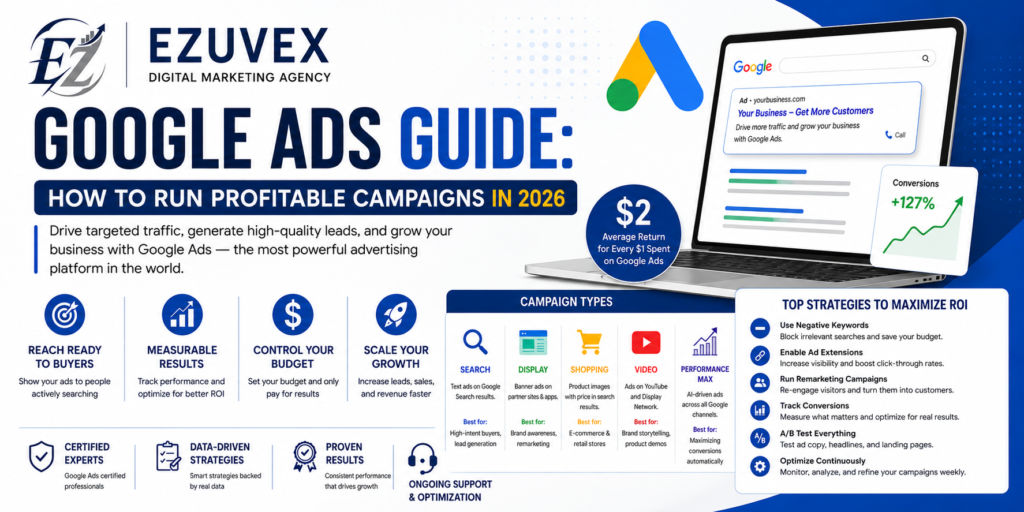
One of the most versatile aspects of the facility of Google Ads is the variety of google ads campaign types available. Each campaign type is designed for a specific marketing objective, allowing you to choose the format that best aligns with your business goals. Here is an overview of the main google ads campaign types:
Search Campaigns: These are text-based ads that appear on Google’s search results pages. They are ideal for capturing high-intent users who are actively looking for your products or services. Search campaigns are the backbone of most Google Ads strategies and deliver some of the highest conversion rates.
Display Campaigns: These campaigns show visual banner ads across millions of websites in Google’s Display Network. They are excellent for building brand awareness, remarketing to past visitors, and reaching a broad audience during the research phase of the buying journey.
Shopping Campaigns: Specifically designed for e-commerce businesses, shopping campaigns display your products with images, prices, and store names directly in the search results. They are highly effective for driving online sales and showcasing your product catalog.
Video Campaigns: These run on YouTube and across Google’s video partner network. Video campaigns are powerful for brand storytelling, product demonstrations, and reaching audiences through engaging visual content.
App Campaigns: Designed to drive app installs and in-app conversions, these campaigns run across Google Search, Play Store, YouTube, and the Display Network simultaneously.
Performance Max Campaigns: Google’s newest and most automated campaign type uses AI to optimize delivery across all Google channels simultaneously, finding the best-performing combinations of ads, audiences, and placements.
Understanding which of these google ads campaign types is right for your business is a critical step in leveraging the full facility of Google Ads. At Ezuvex, we evaluate your business goals, target audience, and budget to recommend the ideal campaign mix for maximum impact.
3. Precise Google Ads Targeting Capabilities
The google ads targeting options available within the platform represent one of its most impressive facilities. Unlike traditional advertising that casts a wide net and hopes for the best, Google Ads allows you to define exactly who sees your ads based on multiple layered criteria.
Keyword Targeting: The foundation of google ads targeting is keyword selection. You choose the search terms that should trigger your ads, giving you control over the intent signals your ads respond to.
Geographic Targeting: You can target users in specific countries, cities, regions, or even a radius around a specific location. This is invaluable for local businesses that only serve customers in a particular area.
Demographic Targeting: Google Ads allows you to narrow your audience by age, gender, household income, and parental status, ensuring your ads reach the most relevant demographic segments.
Device Targeting: You can adjust bids and show different ads based on whether users are on desktop computers, mobile phones, or tablets — allowing you to optimize the experience for each device type.
Audience Targeting: This includes in-market audiences (people actively researching purchases), affinity audiences (people with long-term interests), custom intent audiences, remarketing lists, and customer match audiences based on your own customer data.
Time and Day Targeting: The facility of Google Ads includes the ability to schedule your ads to run only during specific hours or days of the week — ensuring you reach your audience when they are most likely to convert.
This level of google ads targeting precision is what separates Google Ads from almost every other advertising platform in existence and makes it such a powerful tool for professional digital marketers.
4. Full Budget Control and Flexible Spending
A major facility of Google Ads that makes it accessible to businesses of all sizes is its flexible budget control system. There is no minimum spend requirement — you can start with as little as a few hundred taka per day and scale up as you see results. This democratic approach to advertising means that a small local business can compete alongside large corporations on the same platform.
Within Google Ads, you control your budget at multiple levels. At the campaign level, you set a daily budget — the maximum amount Google can spend on your campaign per day. Within each ad group, you set bids — the maximum amount you are willing to pay for a click on a specific keyword. Google uses these parameters along with your Quality Score and Ad Rank to determine when and where your ads appear.
The pay-per-click advertising model means you only pay when someone actually clicks your ad. This eliminates wasted spending on impressions that generate no engagement. Combined with conversion tracking, you can calculate exactly how much you are paying per lead or sale — making budget optimization straightforward and data-driven.
5. Measurable Google Ads ROI and Real-Time Reporting
Perhaps the most significant facility of Google Ads for business owners and marketers is the ability to measure everything with precision. Unlike traditional advertising where it is nearly impossible to know exactly how many sales a billboard or TV commercial generated, Google Ads provides complete transparency into campaign performance.
The Google Ads dashboard shows you exactly how many impressions your ads received, how many people clicked, what your click-through rate is, how many conversions were generated, and what your cost per conversion is. This data updates in real time, allowing you to make informed decisions quickly. You can pause underperforming ads, increase bids on top-performing keywords, and continuously refine your campaigns based on actual performance data.
Google Ads ROI tracking is made even more powerful through integration with Google Analytics and Google Tag Manager. By linking these tools, you gain visibility into the entire customer journey — from the first ad click through to purchase or lead submission. This end-to-end tracking capability allows for sophisticated attribution analysis and budget allocation decisions that maximize google ads ROI.
As highlighted by Linear Design’s comprehensive Google Ads guide, Google Ads rewards relevance and quality — not just big budgets. By focusing on strong keyword strategies, a high Quality Score, and continuous optimization, you can achieve a significant measurable return on investment regardless of the size of your business.
6. Quality Score and Ad Rank System
An often-overlooked but critically important facility of Google Ads is its Quality Score system. Quality Score is Google’s rating of the relevance and quality of your keywords, ads, and landing pages. It is scored on a scale of 1 to 10 and directly influences both your Ad Rank and your cost per click.
A higher Quality Score means your ads will appear in better positions at lower costs — essentially rewarding advertisers who create genuinely relevant, helpful ads. This levels the playing field and ensures that businesses with smaller budgets can compete effectively if they invest in creating high-quality, relevant ad experiences.
The facility of Google Ads in this respect is unique — it is not a simple highest-bidder-wins system. Instead, it balances bid amount with relevance metrics, creating an ecosystem where smart, strategic advertisers outperform those who simply throw money at the platform.
7. Remarketing and Audience Retargeting
One of the most powerful advanced facilities of Google Ads is remarketing — the ability to show targeted ads specifically to people who have previously visited your website. Studies consistently show that most visitors do not convert on their first visit to a website. Remarketing allows you to re-engage those visitors as they browse other websites across Google’s Display Network, reminding them of your products or services and bringing them back to complete a purchase.
The facility of Google Ads through remarketing includes standard remarketing (showing ads to past visitors), dynamic remarketing (showing ads featuring the specific products or services a visitor viewed on your site), customer list remarketing (targeting existing customers with specific messages), and similar audiences (reaching new users who share characteristics with your best customers).
At Ezuvex, we implement sophisticated remarketing strategies for our clients that significantly reduce cost per acquisition and improve overall campaign efficiency. Remarketing is often the highest-ROI component of a comprehensive Google Ads strategy.
8. Google Ads Extensions and Enhanced Ad Formats
The facility of Google Ads includes a wide range of ad extensions that allow you to add additional information to your ads beyond the standard headline and description format. These extensions increase the size and visual prominence of your ads, provide more value to users, and typically improve click-through rates.
Key ad extensions include sitelink extensions (links to specific pages on your website), callout extensions (short additional benefits or features), call extensions (a phone number directly in the ad), location extensions (your business address), structured snippet extensions (lists of products, services, or features), and price extensions (showing pricing for specific products or services).
These extensions are free to add and can significantly enhance the performance of your campaigns. The facility of Google Ads in offering these diverse ad formats ensures that your ads stand out in a crowded search results page and provide users with the information they need to make a confident click.
9. AI-Powered Optimization and Smart Bidding
Modern Google Ads is deeply integrated with artificial intelligence and machine learning, creating powerful automated optimization capabilities that were simply not possible in the early days of pay-per-click advertising. Smart Bidding strategies — including Target CPA (cost per acquisition), Target ROAS (return on ad spend), Maximize Conversions, and Enhanced CPC — use Google’s AI to automatically adjust your bids in real time based on a wide range of contextual signals.
These signals include the user’s device, location, time of day, search query, browsing history, and much more — factors that would be impossible for a human to analyze and respond to manually at the speed of a Google auction. The AI-powered facility of Google Ads means your campaigns are continuously optimizing themselves to find the highest-value clicks within your budget constraints.
This does not mean you should simply set campaigns and forget them — human oversight, strategic direction, and regular analysis are still essential. But AI-powered bidding dramatically reduces the manual work required to maintain peak performance and allows campaigns to respond to market changes in real time.
10. Competitive Intelligence and Market Insights
The final major facility of Google Ads we will explore is the access it provides to competitive intelligence and market insights. The Google Ads platform includes tools like the Keyword Planner (for researching search volumes and bid estimates), the Auction Insights report (showing how your performance compares to competitors), and the Search Terms report (revealing the actual queries that triggered your ads).
These tools give you a window into your market that is extraordinarily valuable for strategic decision-making. You can see which keywords your competitors are bidding on, understand market search demand for your products or services, identify gaps in your keyword strategy, and uncover new opportunities for growth.
How to Use the Facility of Google Ads — Step by Step
Step 1: Define Your Campaign Goals and KPIs
The first step to successfully using the facility of Google Ads is to define clear, measurable goals. Are you trying to drive website traffic? Generate phone leads? Increase e-commerce sales? Build brand awareness? Your goals will determine which google ads campaign types you use, how you structure your campaigns, and which metrics you use to measure success.
Step 2: Conduct Thorough Keyword Research
Keyword research is the foundation of effective pay-per-click advertising. Use the Google Keyword Planner tool along with third-party tools like SEMrush or Ahrefs to identify the keywords your target audience is searching for. Focus on a mix of high-intent transactional keywords and informational keywords that align with different stages of the buyer’s journey.
Step 3: Structure Your Campaigns and Ad Groups
Proper campaign structure is essential for maximizing Quality Scores and optimizing performance. Organize your campaigns by product line, service type, or geographic area. Within each campaign, create tightly themed ad groups where each group contains closely related keywords and highly relevant ads. This tight thematic alignment improves Quality Scores and overall campaign efficiency.
Step 4: Write Compelling Ads That Drive Clicks
Your ad copy is what persuades users to click — making it one of the most important elements of your Google Ads strategy. Write clear, specific headlines that include your target keywords and communicate a strong value proposition. Use your description lines to highlight key benefits, include a call to action, and differentiate yourself from competitors. Test multiple ad variations using Responsive Search Ads to let Google’s AI identify the best-performing combinations.
Step 5: Optimize Your Landing Pages for Conversion
The facility of Google Ads does not end with getting clicks — converting those clicks into customers requires highly optimized landing pages. Your landing page should be directly relevant to the ad that brought the user there, load quickly on all devices, clearly communicate your value proposition, and include a prominent, compelling call to action. A poor landing page will waste your ad budget regardless of how well your campaigns are set up.
Benefits of the Facility of Google Ads for Your Business
The google ads benefits for businesses are extensive and well-documented. Google Ads provides immediate visibility — unlike SEO which can take months to show results, a well-configured Google Ads campaign can generate clicks and conversions within hours of going live.
The facility of Google Ads offers unparalleled scalability — you can start small and grow your investment as you validate your returns. The pay-per-click advertising model ensures efficiency — you only pay for actual engagement, not passive impressions.
The comprehensive reporting and analytics capabilities give you the data needed to continuously improve performance and allocate budget to the highest-performing campaigns. Additionally, the facility of Google Ads integrates seamlessly with other Google tools like Analytics, Search Console, and Google Merchant Center — creating a powerful, interconnected ecosystem for digital marketing success.
Common Mistakes to Avoid with the Facility of Google Ads
Even with the best intentions, many businesses fail to get the results they expect from Google Ads because of avoidable mistakes. Understanding these pitfalls is as important as understanding the facility of Google Ads itself.
Neglecting Negative Keywords: Not adding negative keywords is one of the most costly mistakes in pay-per-click advertising. Negative keywords prevent your ads from showing for irrelevant searches, ensuring your budget is spent only on relevant traffic. Failing to use them results in wasted spend and poor conversion rates.
Poor Campaign Structure: Mixing too many different themes within a single ad group reduces Quality Scores and makes it difficult to write highly relevant ads. Always maintain tight thematic groupings.
Ignoring Quality Score: Many advertisers focus only on bids while ignoring Quality Score. Since Quality Score directly affects your Ad Rank and cost per click, improving relevance at every level — keyword, ad copy, and landing page — is essential for the facility of Google Ads to deliver optimal results.
Failing to Test Ad Variations: Running only one ad variation means missing out on optimization opportunities. Always run at least two or three ad variations per ad group and use the data to identify winners.
Not Setting Up Conversion Tracking: Without proper conversion tracking, you cannot measure google ads ROI accurately. This is a non-negotiable requirement for any serious Google Ads campaign.
Setting and Forgetting Campaigns: The facility of Google Ads requires ongoing attention and optimization. Regular bid adjustments, negative keyword additions, ad copy testing, and landing page improvements are essential for maintaining strong performance over time.
Frequently Asked Questions About Facility of Google Ads
Q: What is the facility of Google Ads and how does it work? A: The facility of Google Ads refers to the complete set of tools, features, and capabilities offered by Google’s pay-per-click advertising platform. It works through an auction system where advertisers bid on keywords, and Google displays their ads to users searching for those terms, charging only when someone clicks the ad.
Q: How do the different google ads campaign types work? A: Google Ads offers multiple campaign types including Search, Display, Shopping, Video, App, and Performance Max. Each serves different marketing goals — search campaigns capture high-intent users, display campaigns build brand awareness through pay-per-click advertising across the web, shopping campaigns showcase products, and video campaigns engage audiences on YouTube.
Q: Why is google ads targeting so important for campaign success? A: Precise google ads targeting ensures your ads are shown only to the most relevant audience segments based on keywords, location, demographics, device, time, and audience behaviors. Without proper targeting, you waste budget on irrelevant clicks that will never convert into customers.
Q: How much does it cost to use the facility of Google Ads? A: Google Ads has no minimum budget requirement. You control your daily budget and set bids for each keyword. Costs vary by industry — competitive keywords cost more per click than niche ones. Working with a specialist like Ezuvex helps ensure your budget is allocated efficiently for maximum google ads ROI.
Q: How do I get started with the facility of Google Ads for my business? A: Getting started with the facility of Google Ads involves creating a Google Ads account, defining your campaign goals, conducting keyword research, setting up your campaign structure, writing compelling ads, and configuring conversion tracking. For best results, partner with an experienced digital marketing agency like Ezuvex to set up and manage your campaigns professionally from day one.